

Category Mining Equipment
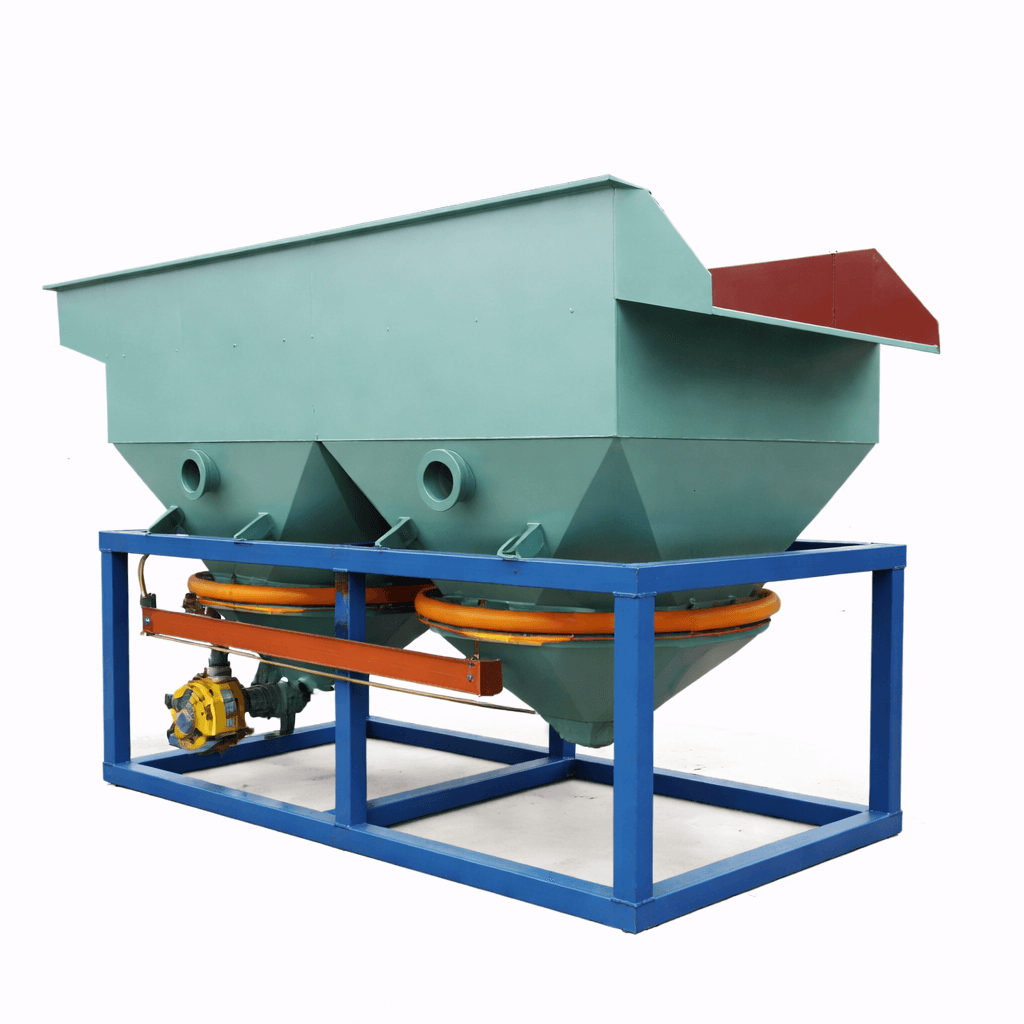
JT Sawtooth Wave Jigger
The JT Sawtooth Wave Jigger is a gravity separation machine that uses a pulsating water flow to stratify material and recover heavier minerals from mixed feed in mining and slag-recovery circuits.
Pricing Disclaimer: All pricing is subject to change and may be impacted by tariffs, duties, shipping rates, and international market conditions. Final pricing will be confirmed at the time of order placement and locked in once a purchase agreement is issued.
Share Product :
The JT Sawtooth Wave Jigger is a gravity separation unit designed to concentrate heavier minerals from lighter gangue using a controlled, pulsating water flow. It is widely used across mineral processing circuits for materials such as gold, tungsten, tin, iron, manganese, titanium, chromium, sulfur, coal, and diamond, and it is also used in smelting slag recovery (including manganese slag, chromium slag, and stainless-steel slag) as well as metal recovery from tailings.
In operation, feed enters the jigging chamber where a repeating stroke creates a vertical water pulsation. That pulsation drives stratification: higher-density particles settle toward the bottom while lighter particles remain higher in the bed. Adjustable stroke and jig frequency help tune the separation to the feed’s size distribution and density contrast, and discharge arrangements remove concentrate and tailings as the bed develops.
This matters in circuits where you need a durable, continuous gravity step that can handle variable feed and still deliver a stable separation. The JT Sawtooth Wave Jigger is designed to support higher handling rates, improve recovery across a wider particle-size window, and increase recovery of valuable minerals in medium-fine fractions when conditions are properly set.
It is typically a good fit for operations running gravity concentration ahead of flotation, magnetic separation, or further upgrading, and for plants targeting metal recovery from slag or tailings where density separation provides a cost-effective first pass.
Selection is usually driven by the jigging chamber geometry and total area, maximum feed size capability, expected throughput in tons per hour (TPH), and available water consumption. The technical table below compares models by chamber form and dimensions, stroke coefficient, feed size limit, capacity, water consumption, stroke and frequency ranges, motor details, overall dimensions, and weight.
If you can share your target mineral, feed sizing, expected throughput, and whether you are working in a primary ore circuit, tailings recovery, or slag recovery application, we can help narrow the JT model range and discuss how it would integrate with screening and classification upstream.
Use this table to compare JT Sawtooth Wave Jigger models by jigging chamber configuration and area, maximum feed size, stated capacity in TPH, water consumption, adjustable stroke and jig frequency ranges, motor power, overall dimensions, and machine weight.
| Model | JT-0.57 | JT1-1 | JT2-2 | JT3-1 | JT4-2 | JT5-2 | |
| Jigging Chamber | Section Form | Trapezium | Trapezium | Rectangle | Trapezium | Rectangle | Trapezium |
| Length*Width (mm) | 450~750×950 | 450~900×1500 | 1070×1070 | 960~2000×1950 | 1510×1510 | 1200~2000×3150 | |
| Column Number | Single | Single | Single | Single | Single | Single | |
| Jig Chambers(psc) | 1 | 1 | 2 | 1 | 2 | 2 | |
| Single chamber area (㎡) | 0.57 | 1 | 1.14 | 3.3 | 2.43 | 2.12(single chamber) 2.77(double chamber) | |
| Total area(㎡) | 0.57 | 1 | 2.28 | 3.3 | 4.86 | 5 | |
| Stroke Coefficient | 0.57 | 0.64 | 0.45 | 1 | 0.58(single power) 0.45(dual power) | 0.58(single power) 0.45(dual power) | |
| Max feed size (mm) | 6 | 5 | 10 | <20 | 8, plus sieve automatic discharge <60 | 8, plus sieve automatic discharge <60 | |
| Capacity (TPH) | 1~2.5 | 2~3 | 4~8 | 10~15 | 12~16 | 10~20 | |
| Water Consumption(m³/h) | 1~2 | 2~3 | 2~4 | 3~6 | 4~8 | 5~10 | |
| Separator | Stroke (mm) | 12,17,21 | 12,17,21 | 12,17,21 | 10~47 adjustable | 10~30 | 15,20,25 |
| Jig frequency (min-1) | 60~156 adjustable | 60~156 adjustable | 60~156 adjustable | 80~100 adjustable | 80~120 adjustable | 80~120 adjustable | |
| Motor | Model | YCT 132-4B | YCT 100L-6 | YCT32-4 | YCT-4B | YCT 160-4B | YCT 200-4A |
| Power (kW) | 1.5 | 2.2 | 3 | 5.5 | 5.5 (dual power) 7.5 (single power) | 5.5 (dual power) 7.5 (single power) | |
| Overall Dimension (Length*Width*Height) mm | 1530×780×1550 | 2060×1112×1890 | 2870×1520×1880 | 2662×2000×3030 | 4240×1990×2750 | 3940×2006×2580 | |
| Weight(kg) | 612 | 989 | 1637 | 3260 | 3500 | 3854 | |
| Notes: The above data is only for your reference, capacity and hutch water varying from ore granularity, ore property and operating condition. | |||||||
Product Specification Disclaimer:
While Bros Dirt Diggers makes every effort to ensure product specifications and details are accurate, final equipment specifications are subject to manufacturer confirmation. Customers should verify all critical details before purchase.
Customize Your Own Crushing Plant Now
Fill your requirements here, and we’ll send the custmized solution and quotation to you by the reserved contact information.
Related Product
Get in Touch
We’re always here to help with your equipment and plant needs.
Send Us a Message
Tell us what you’re working on — our team will help you find the right equipment or solution.
572V+75W Octave, Arizona, USA
Call Center 1
541-513-4542
541-513-4542
Call Center 2
480-241-2454
480-241-2454
brosdirtdiggersllc@gmail.com