
Category Mining Equipment
LL Spiral Chute
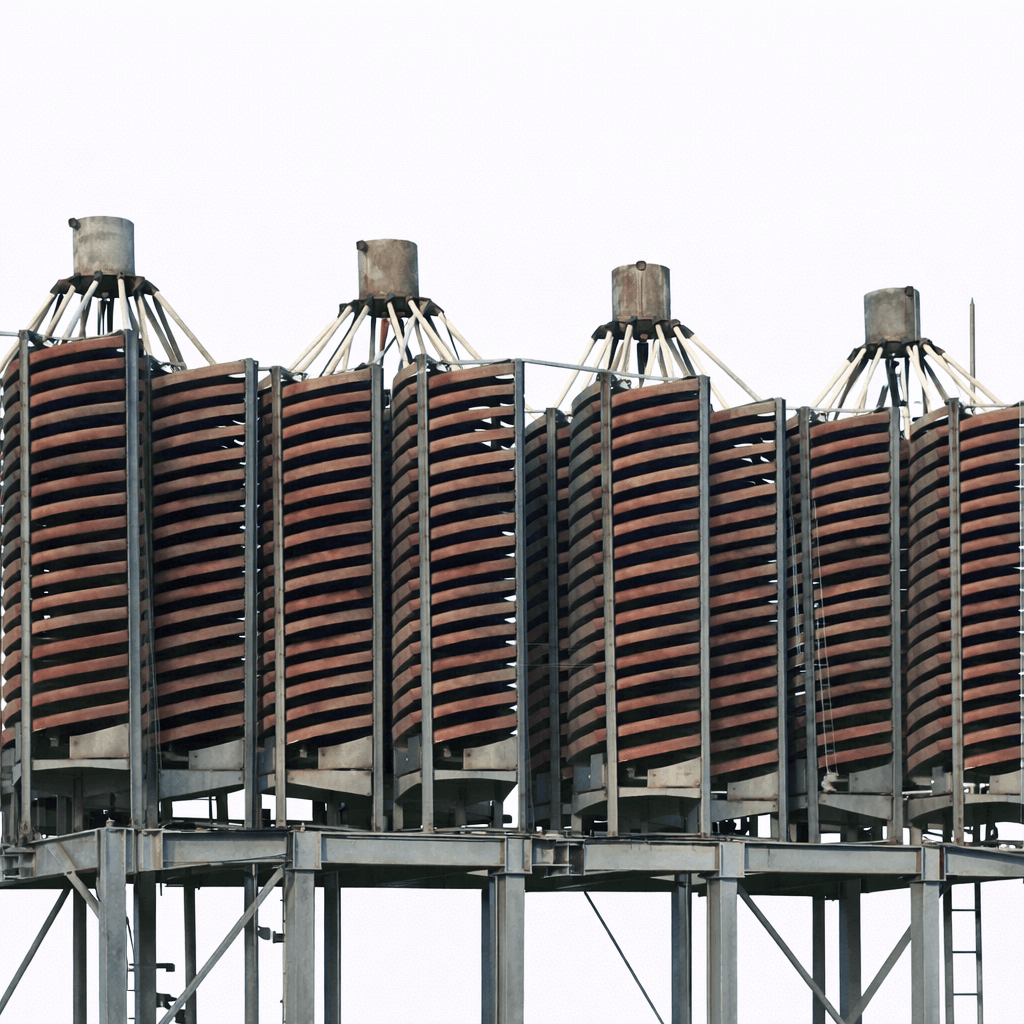
The LL Spiral Chute is a gravity separation unit that uses a spiral flow path to concentrate minerals by specific gravity differences in fine to small granular feeds.
Pricing Disclaimer: All pricing is subject to change and may be impacted by tariffs, duties, shipping rates, and international market conditions. Final pricing will be confirmed at the time of order placement and locked in once a purchase agreement is issued.
Share Product :
The LL Spiral Chute is a gravity separation system designed to separate minerals where there is a meaningful difference in specific gravity. It is commonly used for metallic minerals and industrial minerals across fine feed ranges, including applications involving iron, ilmenite, chromite, pyrite, tungsten, tin, tantalum-niobium, zircon, rutile, and other nonferrous, rare metal, and nonmetallic materials.
Material is fed as a slurry to the top of the spiral. As the slurry travels down the helix, the combination of gravity, centrifugal effect, and fluid drag causes heavier particles to migrate toward one zone of the trough while lighter particles move toward another. Splitters and discharge points separate the resulting streams, producing a concentrate and a tailings fraction without the need for powered internal mechanisms.
This approach matters in circuits where low operating complexity and continuous, stable separation are priorities. With no internal moving parts, spiral chutes can support steady operation while helping reduce maintenance burden, and they can be configured to suit different feed rates and slurry densities within the limits of the application.
The LL Spiral Chute is typically a good fit for mines and mineral processing plants running gravity concentration ahead of flotation, magnetic separation, or other upgrading steps, as well as for sand, gravel, and industrial mineral operations looking to remove lighter waste or upgrade a heavy mineral fraction.
When selecting a unit, the most practical sizing factors are feed size range, feed density, and desired throughput in tons per hour (TPH), along with available installation height. The technical table below lists each model’s external diameter, pitch options, feed size range, feed density range, stated capacity, overall dimensions, and weight.
If you share your target mineral, expected feed sizing, slurry density, and capacity requirement, we can help confirm fit and discuss how a spiral chute would be staged in your classification and concentration circuit.
Use this table to compare LL Spiral Chute models by external diameter, pitch options, feed size range, feed density range, and stated capacity in TPH. It also lists overall dimensions and weight for layout and installation planning.
| Model | LL-2000 | LL-1500 | LL-1200 | LL-900 | LL-600 | |
| External Diameter (mm) | 2000 | 1500 | 1200 | 900 | 600 | |
| Pitch (mm) | 1200 | 720,540 | 720,540 | 540,405 | 450,360 | |
| Cross Dip (°) | 9° | 9° | 9° | 9° | 9° | |
| Spiral Quantity | 1~3 | 1~4 | 1~4 | 1~4 | 1~3 | |
| Max turns of Spiral | 4 | 5 | 5 | 5 | 5 | |
| Feed Size (mm) | 4-0.04 | 0.8-0.037 | 0.3-0.03 | 0.3-0.03 | 0.2-0.02 | |
| Feed Density (%) | 20-45 | 25-50 | 25-55 | 25-55 | 25-55 | |
| Capacity (TPH) | 15-40 | 6-8 | 4-6 | 2-3 | 0.8-1.2 | |
| Overall Dimension | Length (mm) | 2300 | 1560 | 1360 | 1060 | 700 |
| Width (mm) | 2300 | 1560 | 1360 | 1060 | 700 | |
| Height (mm) | 6500 | 5230、4360 | 5230、4360 | 4000、3325 | 2600、2150 | |
| Weight (kg) | 1350 | 800 | 600 | 400 | 150 | |
| Notes:1. The above technical parameters calculated based on max spiral quantity and max pitch. Specific data is subject to actual machine. 2. The feed concentration (percentage) is not absolute amount. 3. Spiral chute is different from screw pitch and the total height of corresponding spiral chute is also different. | ||||||
Product Specification Disclaimer:
While Bros Dirt Diggers makes every effort to ensure product specifications and details are accurate, final equipment specifications are subject to manufacturer confirmation. Customers should verify all critical details before purchase.
Customize Your Own Crushing Plant Now
Fill your requirements here, and we’ll send the custmized solution and quotation to you by the reserved contact information.
Related Product
Get in Touch
We’re always here to help with your equipment and plant needs.
Send Us a Message
Tell us what you’re working on — our team will help you find the right equipment or solution.
572V+75W Octave, Arizona, USA
Call Center 1
541-513-4542
541-513-4542
Call Center 2
480-241-2454
480-241-2454
brosdirtdiggersllc@gmail.com