
Category Crushing Equipment
S Spring Cone Crusher
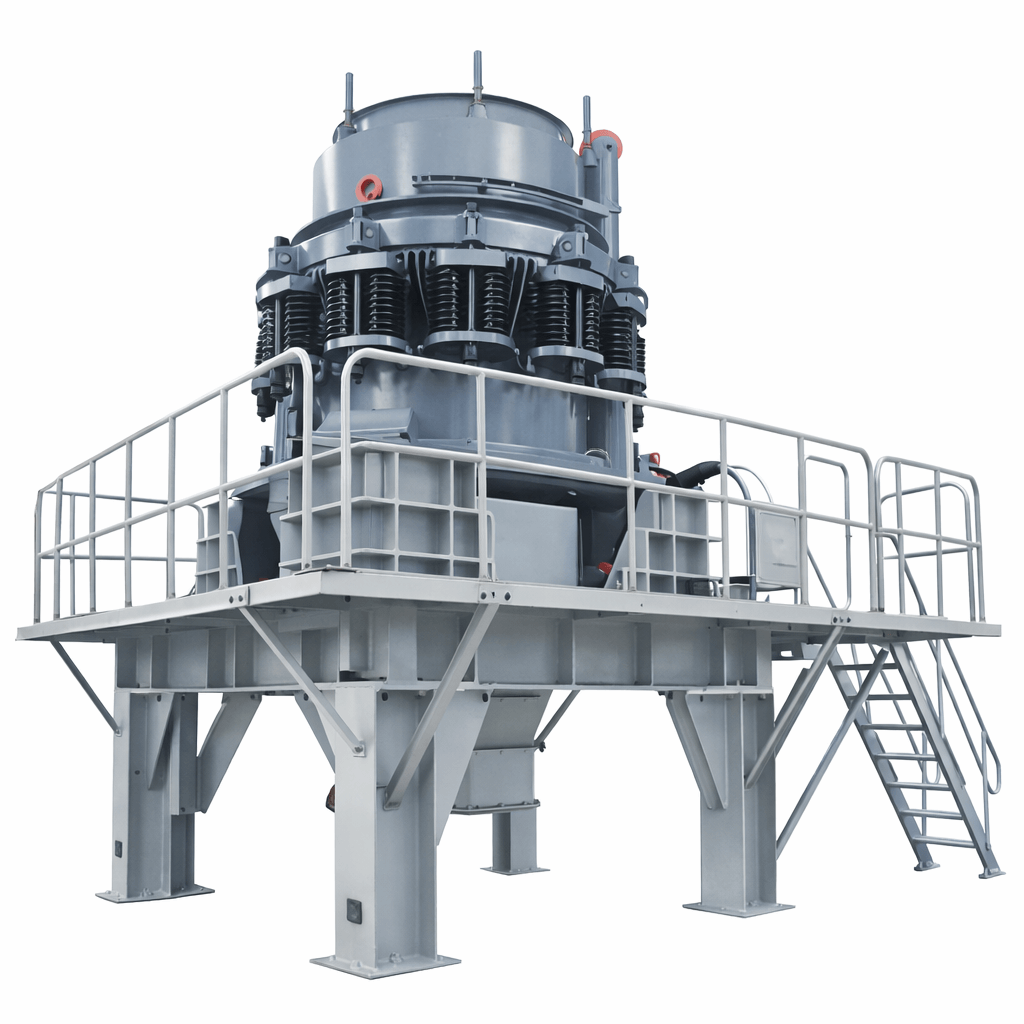
The S Spring Cone Crusher is a versatile cone crusher designed for secondary and tertiary crushing of hard and abrasive materials in aggregate and mining operations.
Pricing Disclaimer: All pricing is subject to change and may be impacted by tariffs, duties, shipping rates, and international market conditions. Final pricing will be confirmed at the time of order placement and locked in once a purchase agreement is issued.
Share Product :
The S Spring Cone Crusher is built around the lamination crushing principle, focusing on crushing more and grinding less to improve product shape and overall efficiency. It is commonly used in aggregate production, infrastructure construction, and mineral processing where consistent output and dependable operation are required.
Material enters the crushing chamber and is compressed in multiple layers between the mantle and concave. This lamination-based process reduces excessive fines while improving particle shape, producing more cubical aggregates and maintaining stable throughput across varying operating conditions.
This crushing approach helps extend wear life and maintain reliable performance over long operating cycles. The classic mechanical structure supports stable operation, while the hydraulic lubrication system simplifies discharge adjustment and chamber cleaning, reducing downtime and routine maintenance effort.
The S Spring Cone Crusher is well suited for operators processing materials such as granite, basalt, marble, iron ore, copper ore, and other hard or medium-hard rock types. It is widely applied in quarry operations, highway and railway construction projects, airport infrastructure, and general aggregate production.
Available in both standard and short-head configurations, the crusher offers multiple chamber options to match different feed sizes and product requirements. Depending on configuration and material characteristics, capacity ranges from 27–140 tons per hour (TPH), with maximum feed sizes up to 369 mm and minimum discharge sizes down to 3 mm.
If you are evaluating a cone crusher for secondary or tertiary crushing, the Bros Dirt Diggers team can help you review chamber selection, capacity targets, and material properties to determine whether the S Spring Cone Crusher is the right solution for your operation.
This crusher supports secondary and tertiary crushing with capacity ranges from 27–1400 TPH, maximum feed sizes up to 369 mm, and minimum output sizes as low as 3 mm, depending on chamber configuration and material characteristics.
Product Specification Disclaimer:
While Bros Dirt Diggers makes every effort to ensure product specifications and details are accurate, final equipment specifications are subject to manufacturer confirmation. Customers should verify all critical details before purchase.
Customize Your Own Crushing Plant Now
Fill your requirements here, and we’ll send the custmized solution and quotation to you by the reserved contact information.
Related Product
Get in Touch
We’re always here to help with your equipment and plant needs.
Send Us a Message
Tell us what you’re working on — our team will help you find the right equipment or solution.
572V+75W Octave, Arizona, USA
Call Center 1
541-513-4542
541-513-4542
Call Center 2
480-241-2454
480-241-2454
brosdirtdiggersllc@gmail.com